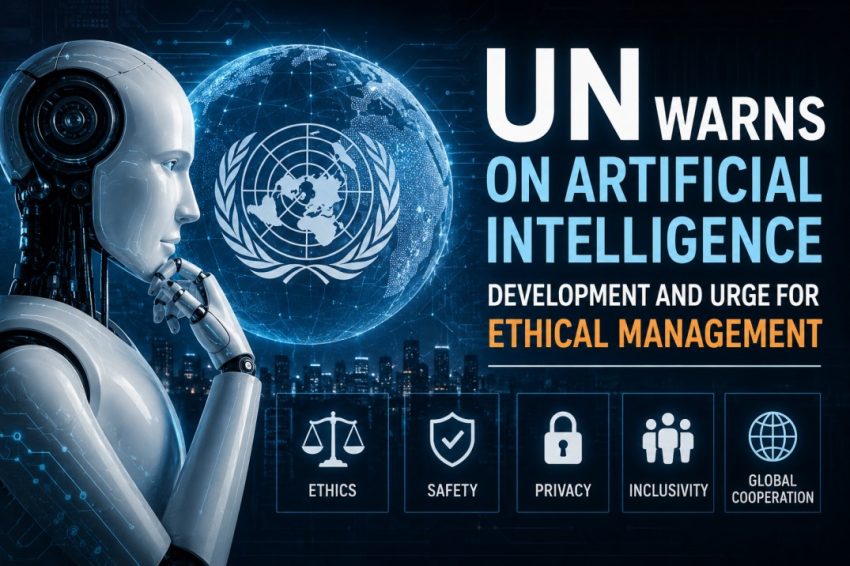
Artificial intelligence (AI) is progressing rapidly and it is almost like the governments and worldwide organizations cannot keep up with regulating it properly. Initially, it was systems that could only answer questions or generate simple texts. Now, it can write software programs, analyze big data, create realistic photos and videos, help scientific research. And even work, with very little human interference.
The UN Independent International Scientific Panel on Artificial Intelligence carried out a preliminary investigation recently and showed the massive potential and risks involved in this ever-developing technology. Their main point is that the opportunity to build the right rules for AI on a global scale is still there but it might be gone before long.
Growing Application of AI
AI is drastically changing some of the most important aspects of human life. In the field of health, it is enabling scientific teams to reveal the shapes of proteins much faster which leads to new medicine research and better understanding of ailments. With AI, doctors can now spot cancer more quickly and health workers in remote areas have the use of AI-enabled diagnostic and treatment assistants in their own languages. And, in agriculture AI is being used to increase the amount of food available. Education systems now use AI to give learners individual help and AI-based accessibility aids enable people living with disabilities. These are just a handful of how it is already making a difference around us.
Key Growing Challenges
The very same technologies are responsible for the development of other types of problems as well. As reported, AI-generated contents with sex and nudity. Mostly those featuring women and children. These are increasing that includes deepfakes and other types of monstrous content. One of the negative impacts of AI is that it is getting involved is the rise of misinformation which results in the erosion of public trust. It is also being used by illegal groups to carry out cyber-attacks, fraud, and other online scams at a large scale. In certain situations, AI-assisted applications even result in increased amounts of undesirable behaviors as well as in exacerbating mental health problems. An additional factor explaining the concern for the environment is the rise of data center, energy consumption and their contribution to greenhouse gas emissions that comes from the growing dependence on AI-based systems.
Growing Disparity
One more big issue is the disparity. The availability of very high-end AI technology is limited mainly to just a few countries and corporations. Most of which are based in the U.S. and China, and these two together own most of the computing power that is used worldwide for AI development. Besides lacking the essential infrastructure to build or efficiently regulate AI systems, many developing countries do not have experts or enough resources for this. Therefore, there is a risk in placed resulting that AI might even increase the disparities among countries instead of decreasing them.
Ethical Guidelines
The UN group points out that in reality the existing governance systems are incomplete and running on old-fashioned ideas. Having over 40 different sets of ethical guidelines and policy structures all over the world is good, but they are so different and no one is taking care of making sure they are followed. At the moment, most of the time companies are the only ones who do the safety testing of the systems that they have been building.
The UN is one of the entities that would like to see more harmonized and strengthened global actions in response to the challenges of AI. An international group of scientists that was set up recently is trying to find out AI’s advantages and disadvantages are now also participating in the global debate on the governance of AI. The aim is to assist nations in making well-informed choices as well as coming up with common rules.
Conclusion
Generally speaking, AI’s future is not set in stone. It is a mighty instrument which on one side, can lessen inequality and raise human well-being. Then again, it can aggravate divisions and risks. What really counts is that, how speedy will the governments, institutions, and societies be in the joint realization of managing the risk of AI. While there is innovation in place, there should also be responsible governance.
Source: By Daniel Dickinson, “AI explained: Why the world needs to act now”, UN News
