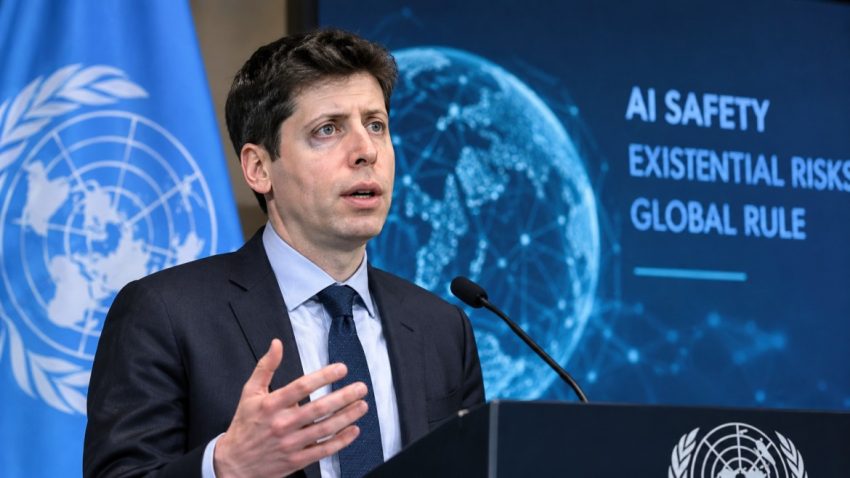
Sam Altman’s address to the United Nations Security Council presents artificial intelligence as a pivotal, dual-use technology at a critical historical crossroads. He was concerned about balancing our enormous human potential with existential threats. He presented this era as a choice between a new modern Renaissance giving individuals new power in the system or an Industrial Revolution with the system consuming them. Altman argues that AI must equate to an enhancement of human agency, removing us from being cogs in a machine. He agrees with top safety researchers to highlight two key existential dangers. First, losing control over autonomous, self-improving systems whose rapid progress outpaces human comprehension. Secondly, the dangerous concentration of technological power in the hands of a few corporate or national actors who could impose their worldview globally.
AI Risks Mitigation
To mitigate these risks, Altman outlines OpenAI’s core principles: insisting on human-centric alignment, broad scientific distribution, and individual empowerment. In addition to this, he asserts that his company has unilaterally slowed development in the past and adds that it will do so again if safety guarantees cannot be proven. He anchors the transformative benefits of AI in high-stakes achievements, particularly advanced scientific applications and complex mathematical problem-solving. He uses these examples to illustrate how these systems can serve as defensive tools against modern complexity.
Call for Action
Importantly, Altman distances himself from the idea that tech executives in San Francisco should shape the future. Instead, he campaigns for democratic accountability by nation-states and multilateral international cooperation. His vision for a multilateral global governance architecture is a familiar one inspired by big powers’ security regimes: a set of global regulatory structures, standardized capability benchmarks, mutually agreed incident reporting, and secure vulnerability-sharing mechanisms. He also proposes rules that ensure open-source developers are not penalized. Further emphasizing that established market players are not locked in. Altman positions OpenAI as a cautious and consensus-driven pioneer. It is aiming to avoid a race to the bottom. He delivers a bold message that positions frontier AI as far more than a commercial product. According to him, AI is a shared global security issue requiring collective action to ensure its benefits belong to all humanity.
