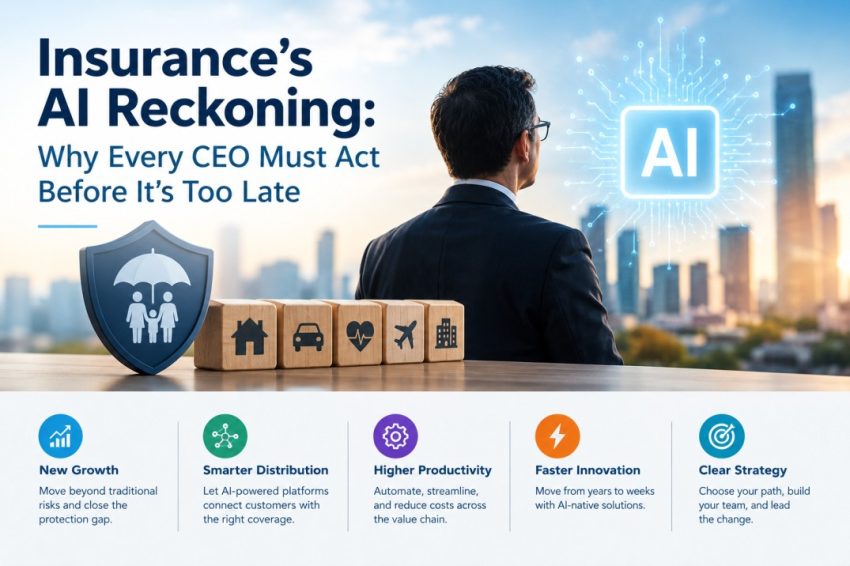
The global insurance sector has largely stagnated over the last two decades. Although premiums have grown at 4.9% annually since 2005, pre-tax profits have grown at only 4.3%, reaching $580 billion. The industry’s economic structure has remained largely unchanged because of rising capital requirements and slow productivity growth. As a result, an insurance executive from 2006 could probably recognize the insurance industry in 2026. Yet, the introduction of AI could finally break this cycle.
Introduction of AI in Insurance
One of the biggest ways AI could transform the insurance industry is by addressing its slow growth and declining relevance. Revenue growth in the insurance sector has consistently lagged behind global GDP growth. The uninsured losses from natural disasters created a protection gap of $133 billion globally in 2025. Meanwhile, cyber insurance has a protection gap of around $900 billion, as less than 1% of global cyber losses are currently insured.
Insurance Coverage and AI
With AI, insurance companies are expanding the types of risks they can cover. For instance, liability risks related to the use of AI technologies and the risk of businesses experiencing operational disruption without physical damage. These are software failures or AI system outage; that are emerging as new categories of insurance. These are often covered under concepts such as business interruption or loss-of-use insurance. On the product side, AI also enables parametric insurance, embedded insurance, and micro-insurance. This allows insurers to provide affordable coverage to individuals and small businesses that were previously uneconomical to insure.
Change Due to AI
Another major change driven by AI is the reduction of distribution costs. Commissions and customer acquisition expenses account for a significant share of insurance costs. In property and casualty insurance, commissions and acquisition costs typically consume 10-25% of every premium dollar. In life insurance, first-year commissions can reach 80 cents for every premium dollar. AI-assisted commerce could significantly disrupt traditional sales channels, particularly in commoditized property and casualty products. As AI assistants begin comparing policies and purchasing coverage on behalf of customers, the industry’s “front door” shifts away from traditional agents toward trusted AI-powered digital marketplaces and platforms.
Productivity
The third major dynamic is productivity. Despite significant investment in digital transformation, global insurance cost ratios remain 10% higher today than they were in 2005. This indicated limited productivity improvement. AI is different because it can improve the entire cost structure simultaneously. Insurance companies could reduce customer onboarding costs by 20-40% through AI-powered automation, while agent productivity could improve by 10-20% through intelligent tools and workflow automation.
Concerns
One of the biggest concerns is the speed of change. Traditional insurance companies operate on product development cycles that often take several years. In contrast, AI-native Managing General Agencies (MGAs) can design, test, and launch products within weeks. The real threat is not whether insurers have access to AI technology, but whether they have an operating model capable of deploying AI quickly enough to remain competitive.
Two Strategies
Two strategies stand out as the most promising paths forward in this AI led insurance sector. First, is scale. Large insurers with sufficient premium volume can spread AI infrastructure costs across their businesses and achieve expense ratios that mid-sized generalist carriers cannot match. Second is deep specialization. Specialized insurers can become exceptionally good at serving one market or solving one risk problem while accessing other capabilities through strategic partnerships.
Conclusion
It is essential for a company to choose a clear and measurable AI ambition and to hold the leaders responsible for delivering it accountable. For example, will the company use AI to provide superior customer access, better products, or stronger risk assessment? The CEO must visibly lead the transformation, while a senior executive should be given full responsibility for execution.
At last, the companies need to prepare for implementation by building or strengthening their delivery engine. This includes upgrading the technology backbone, redesigning the operating model, as well as bringing together the right talent to focus on priority areas.
