
AI is trained through a process in which computer systems learn patterns by analyzing data using mathematical algorithms and models of computation.
AI is not programmed for every possible situation. Instead, it improves its performance by learning from data samples and feedback. It also gets better at a task by programmed improvements through the study of data samples and its response. Information or training data is the basis of all AI training.
This data can be in the form of text, images, audio, video, numeric data, sensor data or recorded interactions etc. For instance, a visual-recognition system is trained on millions/billions of categorized images. The language model is trained on a large corpus of books, news articles, e-magazines and digital text. The more extensive and diverse the data, the more accurate and reliable the model is.
Training Data
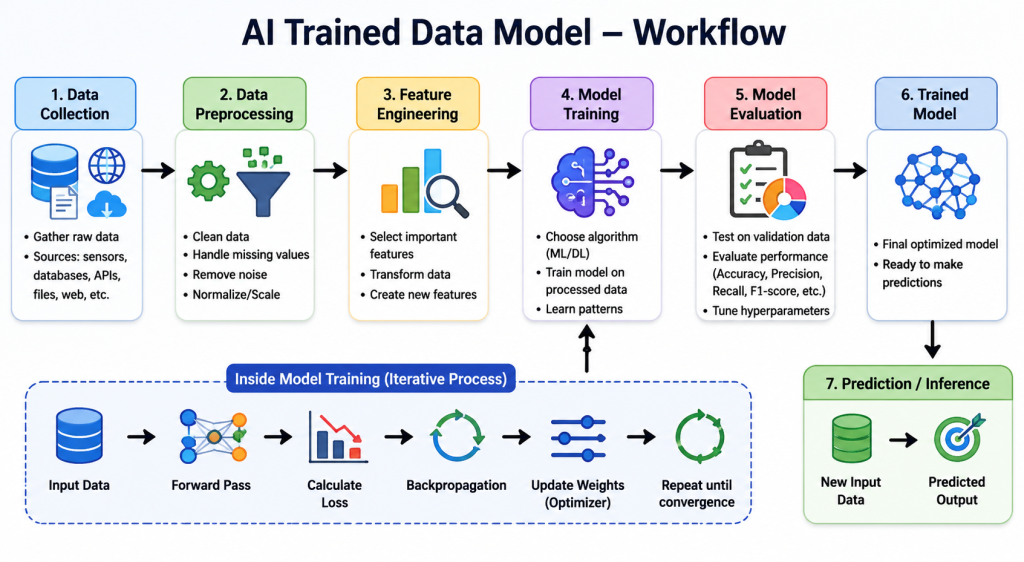
Before training, the data needs to be pre-processed. The data is cleaned of errors and formatted into usable formats. Pre-processing can be handled by humans in supervised systems. In other cases, like in a spam detection model, emails are labeled as either “spam” or “not spam”. These steps should be done carefully as the system learns from the data provided and bad data will lead to bad results. The primary training method used in AI is machine learning.
In training, the model (AI) is given the inputs and attempts to produce an output prediction. The prediction is then compared to the right answer through a mathematical function called a loss function. The amount of error is then calculated and an optimization method, usually gradient descent, modifies the internal weights of the neural network such that the error is minimized. This process is repeated with huge data sets many billions of times.
There are several methods used to train AI. Supervised learning refers to training the model with a set of input-output pairs. Unsupervised learning is the automatic identification of hidden patterns within unlabeled data. Reinforcement learning refers to using reward signals to guide the learning process.
Reinforcement learning is common in robotics and gaming systems as well as dynamic, autonomous decision systems. Developing sophisticated AI models is computationally demanding in which advanced systems often use specialized hardware like Graphics Processing Units (GPUs) or Tensor Processing Units (TPUs). These have the ability to perform parallel calculations rapidly. They can require thousands of processors in data centers over several weeks or months.
Testing
Once training is complete, the model proceeds to the evaluation and testing phase. The developers evaluate the system on new or unseen data that was never before encountered by the system to determine how well it generalizes. Crucial metrics for evaluation are accuracy, precision, recall, and error rate, which varies as the application.
After proper validation, the AI system can be applied to real-world problems like virtual assistants, recommendation engines, medical imaging analysis, fraud detection, language translation, or self-driving cars. A number of systems are periodically retrained with new data, further increasing their accuracy.
At last,
AI training can be seen as a data-centric machine learning process where given enough data, algorithms train themselves to recognize relevant features, make accurate predictions and increase their efficiency with iterations. Training effectiveness relies mostly on data quality, algorithms optimization and processing power.
