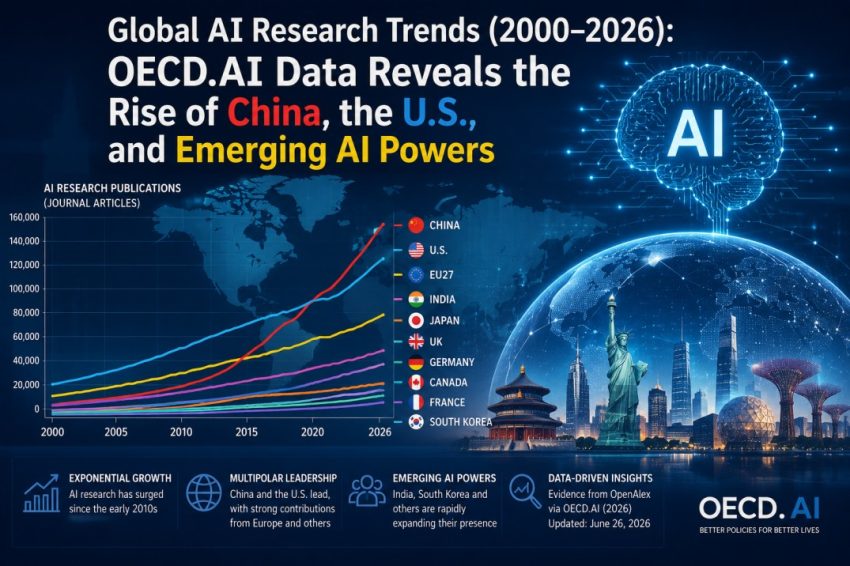
This dataset shows a full picture through the last 26-year period (2000- 2026) of world AI Research output in the form of percentage of the world’s total AI publications. This analysis describes a significant multi-polar power shift in the AI research landscape globally. It is a transition from the dominant position of the West to a fiercely contested as well as multi-centered rivalry. China is by far the major factor and China’s rise is the centerpiece of such global power shift.
Early Dominance
The world AI research landscape of the early 2000s had been completely dominated by one player, i.e. the USA, a typical example of a “unipolar” world. America’s overwhelming share of 27.77% in the entire world’s AI research publications. This was nothing short of a giant compared to China’s pitiful 4.75% share. The EU27, representing the whole European continent, was the next in line with 29.53% globally shared research. Yet compared to the monolithic power of the USA, this was clearly a “dividing head leadership.” A significant shift happened about 2005–2006-time frames. After these years, the USA’s share went down and it was replaced by the EU, whereas China was beginning its steep and almost continuous rise in the share. By the early 21st century, China’s surge has become so impressive that by 2006 it was only a few points behind the EU to the second major place on the world scale at that time. In such a way, it had been a long-standing Western dominance that ended finally with the emergence of China in major player’s rank.
Big Change
The biggest change happened around early to mid-decade-2010s. After having China’s share remained roughly at the 20% level around the beginning of the decade, it went up in the first place and at many moments was even close to 30%. Meanwhile, the number of American publications slowly and gradually decreased until it was just 12% of the global publications of AI in the year of 2023. But, the share of EU27 also went on and on decreasing for a long time since it was 25% in the early 2010s. It dropped to merely 15.88% by the year of 2023. As for India, the country’s research contribution in AI area has increased quite dramatically from 3.44% in 2010 which is expected to be 13.26% in 2026. This way India is going to become another major AI research hub besides the US and China. The data for 2024 and on reveals some of the most fascinating developments. These projections show that China is still the largest producer with a total of 30.43% of world research output projected for 2024. Yet, these data for the years 2025 and 2026 are highly unlikely since the values fluctuate wildly and might be the result of a random change or a new calculation method.
Japan’s Projection
The most striking feature of the data is Japan’s projection, which first increases from a fairly constant 2-3% to an incredibly high 25.53% in 2025 and, after dropping to 1.84 % in 2026, it remains a major question whether it is correct. This erratic fluctuation is, of course, a simple typo and it is only the EU’s share and the US and India’s share with unusual volatility. We believe that this data reflects errors in the projection model for 2025, and the 2026 data (china -27.26%, USA -14.50%, India -13.26%) seem to be in harmony with general historical tendencies. Although China’s share is decreasing slightly, the shares of the USA and India are on the increase.
Conclusion
The data is a concrete, numerical illustration of how AI has gone from being a concentration field in the USA to a global field. It is a picture where the USA has gradually been replaced by China who has taken over the leading role and Europe in total has been the declining side with the distribution of AI capabilities and activities. Yet, in reality India is on the rise and European countries that were strong such as Germany and the UK, still perform very well in AI, guarantees that the competition in AI research and development in the future will not only be bipolar but a complex and world spanning with different centers of excellence. The extent to which a country can carry out its AI-related initiatives is not just about publications but also about the amount of such work.
