The dataset has been extracted from OECD sources over a period of approximately 72 months (2020-2025). It highlights the distribution of AI-related incidents and hazards across major countries. This reveals a clear concentration of reported risks within a small group of technologically advanced nations.
The United States records the highest number of incidents (4697). China follows the US by 942 incidents and the United Kingdom by 794. Next to it, India ranks with 560 incidents, followed by Russia (392).
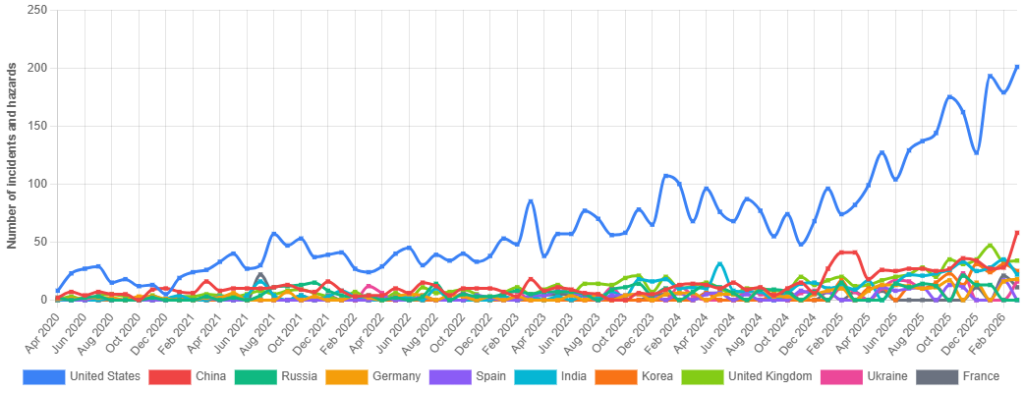
Among European countries, Germany reports 283 incidents followed by Ukraine 223 and Spain reported 184 incidents, France is behind it with 166. In Asia, South Korea records approximately 237 incidents. It indicates a steady level of reported AI-related risks.
Key Insights
The United States alone accounts for nearly five times more incidents than China and shows a significant concentration. On a monthly basis, the US averages around 65 incidents, compared to China (13 per month), the UK (11 per month), and India (8 per month).
This suggests that the United States exhibits both high volume and high volatility. The countries such as Ukraine show a low baseline with occasional crisis-driven spikes.
Additionally, a small group of countries particularly the US, China, and the UK dominate the overall share of reported AI-related incidents globally. This is due to the concentration of both AI deployment and associated risks.
Interpretation
The high number of incidents in the United States likely reflects its large-scale AI deployment driven by extensive digital infrastructure, as well as more developed reporting mechanisms resulting to increase the visibility of hazards.
China and the United Kingdom maintain significant but comparatively controlled levels because of more structured monitoring, regulatory oversight, or differences in reporting practices.
Ukraine’s fluctuations are likely influenced by conflict-related disruptions and infrastructure vulnerabilities which as a result of sudden spikes despite lower overall totals.
Conclusion
United States and China require the robust AI risk management and resilience systems to address sustained exposure to hazards. In contrast, spike-prone countries need stronger crisis response and adaptive governance mechanisms to effectively manage sudden disruptions.
