Since the Industrial and Digital Revolutions, AI is driving the force that is bringing the biggest paradigm shift in the organizational value chain. This new paradigm unites human and AI agents, both working virtually and physically side by side at scale with near-zero marginal cost. McKinsey & Company calls it the agentic organization. In a report published by McKinsey & Company, it is stated that organizations are evolving across four major eras: Craft & Agriculture, Industrial, Digital, and AI (the currently emerging era).
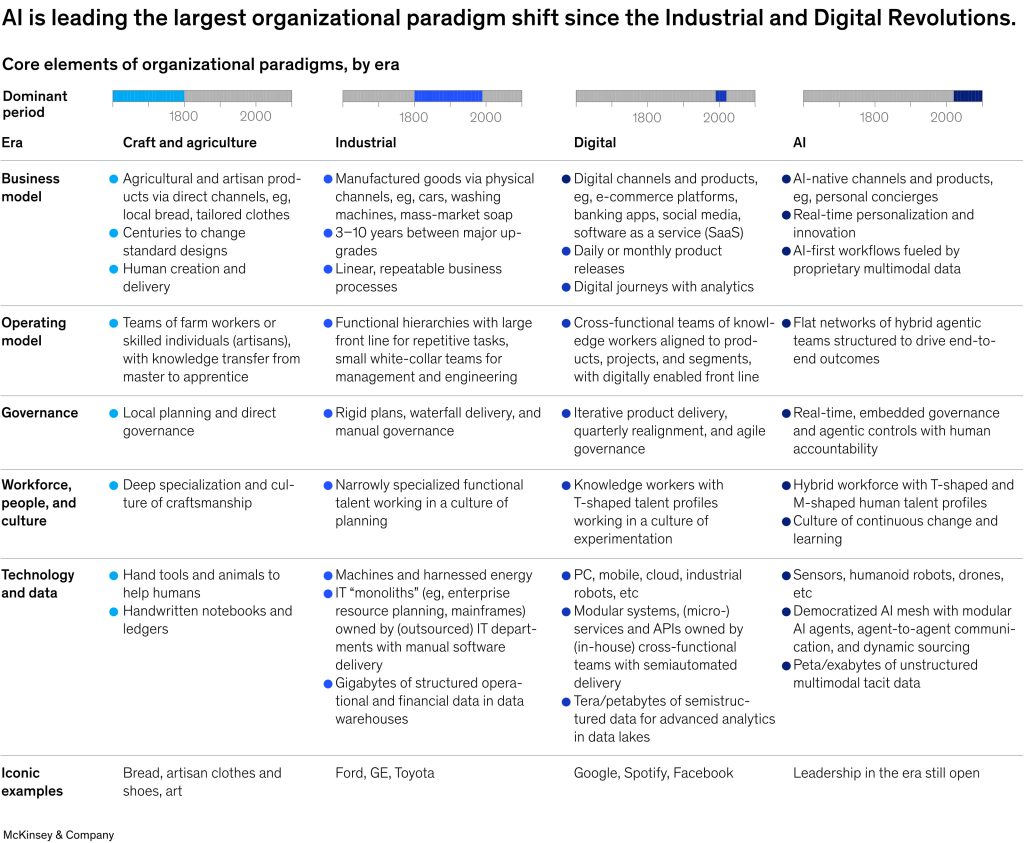
Business Model
In the Craft & Agriculture era, the business model was direct and locally produced. It was human-made and delivered, and design changes were very slow. It took centuries to change designs.
Mass manufacturing via physical channels, which was a linear and repeatable process, characterized the Industrial era. It took around 3-10 years between major upgrades. Digital products and platforms such as e-commerce, SaaS, and mobile applications come under the Digital era. These are released frequently on a monthly or daily basis, with data-driven customer journeys. In the AI era, there are AI-native products and channels, real-time personalization, as well as AI-first workflows powered by proprietary multimodal data.
Operating Model
The operating model has also shifted across these four eras. In the Craft & Agriculture era, it consisted of skilled individuals and apprenticeship. The Industrial era featured functional hierarchies and repetitive frontline labor. The Digital era comprises cross-functional product teams as well as digitally enabled frontline workers. In the AI era, there are flat, hybrid human-AI (agentic) teams focused on end-to-end outcomes.
Governance Model
Governance has also evolved across these four eras. Local and direct governance was present in the Craft & Agriculture era. In the Industrial age, rigid planning and waterfall-type delivery were common. The Digital era emphasizes agile and iterative governance. The AI era features real-time, embedded governance with AI agents and human accountability.
Workforce and Culture Change
Deep craftsmanship was integral to the Craft & Agriculture era. The Industrial era emphasized narrow specialization. The Digital Era is centered around T-shaped knowledge workers and a culture of experimentation.
In this case, T-shaped knowledge designates a professional profile possessing deep, specialized expertise in one area (the vertical bar). On the other hand, collaboration skills across various disciplines (the horizontal bar) are also part of one’s abilities. This combines with a broad ability to collaborate across various disciplines (the horizontal bar). In a T-shaped model, this enables individuals to drive innovation, solve complex problems, as well as communicate effectively within diverse and agile teams.
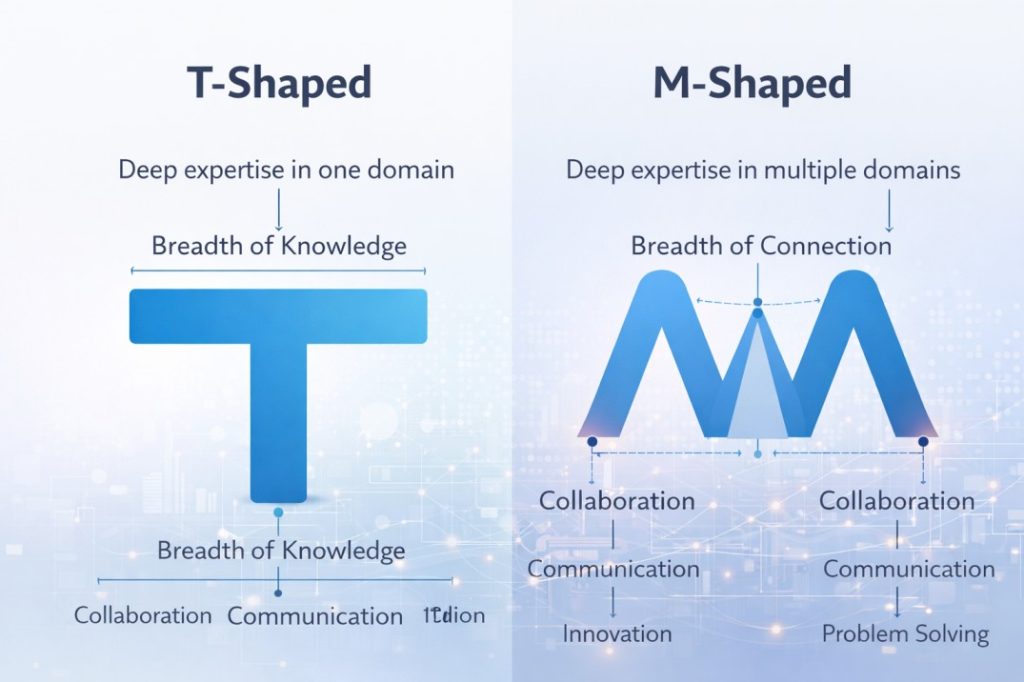
In the AI era, there is a hybrid workforce with T-shaped and M-shaped talent, along with a culture of continuous learning and rapid change. M-shaped talent denotes individuals having deep knowledge in one or more fields but also capable of effectively utilizing several additional skill areas. As a result, such persons recognize patterns and connections as well as opportunities that most people fail to notice.
Technology and Data
Hand tools and notebooks characterized the technology and data progression in the Craft & Agriculture era. Machines and structured data warehouses defined the Industrial era. The Digital era includes cloud computing, APIs, modular systems, and terabytes/petabytes of semi-structured data. In the AI era, technology includes sensors, robotics, and autonomous systems. Moreover, AI agents not only communicate with one another (agent-to-agent communication) but also work together with petabytes/exabytes of unstructured multimodal data.
Iconic Companies
The quintessential companies of each era are the artisan and local producers for the Craft era; Ford and Toyota for the Industrial era; and Google, Facebook, and Spotify for the Digital era. Nonetheless, in the AI era, no clear leaders have yet been established.
Conclusion
Hence, the AI era is a move away from digital tools and towards autonomous and agentic systems. It changes the mode of control from hierarchical to embedded real-time governance. Also, the AI era shifts the focus from specialization to hybrid human-AI collaboration. In addition, it changes the emphasis from data analytics to AI-driven decision and action systems. So, it is not merely a technology update but a total organizational transformation.
