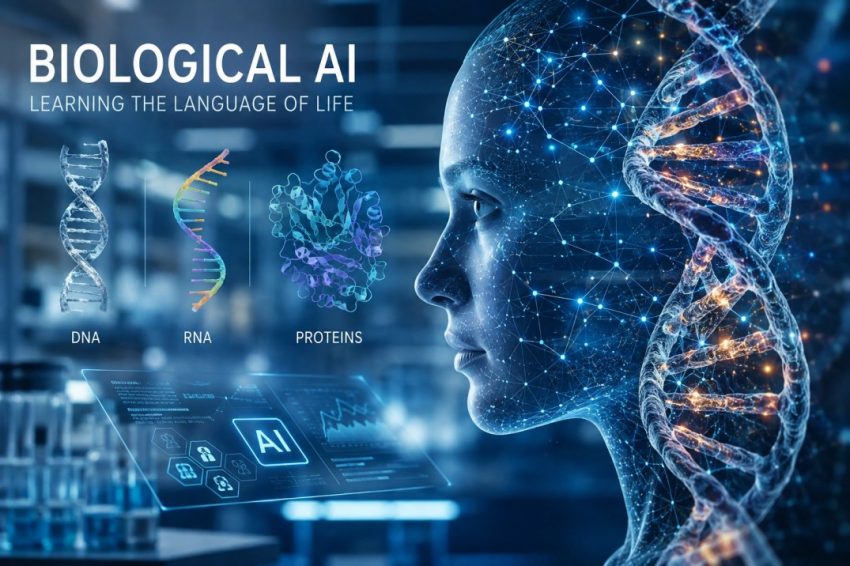
Biological AI is experiencing a structure shift. The importance of the “vocabularies of living” Artificial intelligence is no longer confined to the realms of software, finance and communication. But it is penetrating in the most fascinating and yet the most complex chapter of biology.
An increasing number of model systems are utilized for training the AI models, to correctly interpret DNA RNA proteins and other biological information.
A new report by the European Commission’s JRC on 480 biological AI models offers an overview of the speed of progress and significant unmet needs of the discipline. It analyzes not only the models’ capabilities, but also their readiness to transition into real-world applications.
From Proteins to the “Languages of Life”
Progress has been particularly strong in the field of protein-focused AI, marking an important transition toward understanding the broader “languages of life.” Advances in protein structure prediction, functional annotation, and molecular design are among the most significant achievements in this rapidly evolving field. Years of investment in biology research and resources have resulted in large, curated datasets that are suitable for training powerful AI systems.
The achievement of AlphaFold is a strong example. This process has been achieved for many decades and relied on some enormous biological databases, such as the Protein Data Bank (PDB) and UniProt. Although, development is patchy.
Some fields like single cell biology, for example, have not progressed so far because the data involved tend to be smaller and more fragmented/more poorly standardized. But they could be important in disease understanding and in pharmacogenomics.
The broader lesson is that the availability, quality, and structure of biological data will be a major factor determining how quickly AI advances across different areas of biology. The sectors where high-quality, standardized datasets are abundant, development can progress rapidly contrary to the places where data are limited or fragmented, progress is likely to be slower. This uneven development creates what the report describes as a “maturity paradox” where an AI model may demonstrate advanced capabilities in a scientific domain. But still lack the technological validation and real-world readiness required for practical deployment.
The “Maturity Paradox”
AlphaFold and ESM3 are mature models in their fields. But their scientific success does not necessarily mean they are ready for real world implementation.
Deployment also has taken further validation, safety testing, governance processes, regulatory routes and real-world testing. The report revealed that not one of the models surveyed had achieved a fully integrated readiness assessment. This gap also causes emerging biosecurity issues as biological AI will be more powerful.
Openly available models could be used for adverse biological activities. It increases the necessity of proper governance
Conclusion
Biological AI development opens up far more than just a novel area of artificial intelligence. It points to a very exciting new research direction as the computational systems get more accurate in deciphering the key elements of life. With model complexity growing, the scope of their use as biomedical, drug discovery, synthetic biology, and disease research tools is expected to become broader.
The fate of biological AI, apart from new and bigger models, will also lie in better data, stronger interdisciplinary efforts, ethical decision-making governance and robust safety nets. Policy-makers and researchers’ task is not only to encourage biological AI progress but to accompany its developments through efforts to make these technologies dependable, clear, and safe for their deployment to everyday human life.
