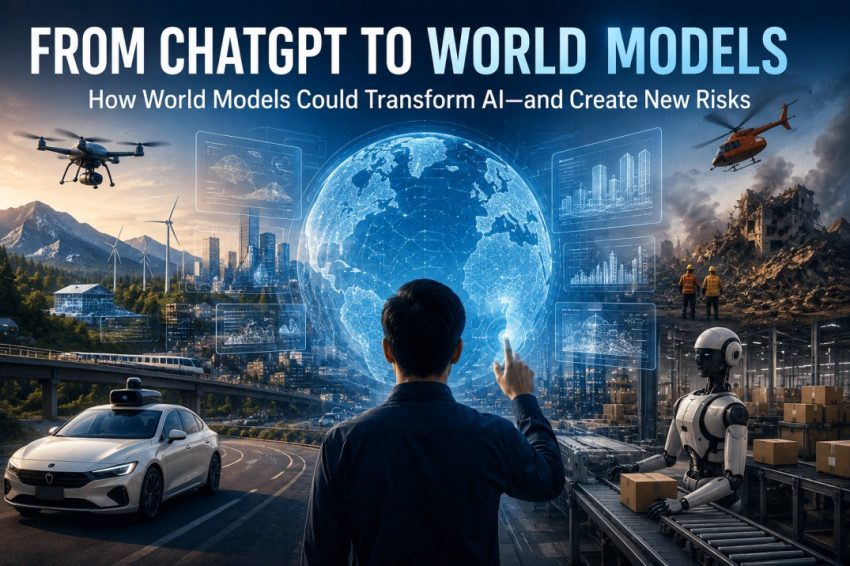
The next phase of AI is emerging, in which machines are expected to do more than simply understand language. They are increasingly expected to sense, discern, anticipate, and act within the physical environment. This technology is known as “world models.” This development has led Stanford researchers to argue that the next phase of AI could create a governance challenge more complicated than regulating large language models (LLMs).
Key Questions
The central policy question is no longer simply what AI says or generates, but what it understands about reality and what actions it enables machines to take. A world model is an internal representation of a physical environment that AI uses to anticipate the consequences of actions within that environment. Such models are used in autonomous vehicles, robotics, emergency response, city planning, industry, and the military. These models are particularly important because they connect AI directly to physical outcomes. An inaccurate language-model output can produce false information only. But an inaccurate world model could cause a vehicle crash, a robotic error, or a disastrous emergency response.
Functions of World Models
The Stanford analysis distinguishes three broad functions of world models: renderers, simulators, and planners. Renderers generate photorealistic representations of environments, simulators model underlying physical processes, and planners propose or carry out actions. This distinction is important because regulatory requirements should become stricter as AI moves from generating representations toward making safety-critical decisions. Therefore, policymakers should not treat all world models as a single category. If done so, it could result in excessive regulation of low-risk applications or inadequate oversight of high-risk systems.
The determination of whether a simulation accurately represents the real world is the most significant issues. There is a risk of simulated environments could appear convincing without being physically accurate. Let us consider an autonomous vehicle that is trained, validated, as well as tested in a simulation environment. However, it may fail to adequately account for the dangers of wet roads. The vehicle could perform exceptionally well in testing without actually being safe in real-world conditions.
Interconnected Issues
This issue creates significant challenges for regulation. Policymakers cannot assume that high performance in a synthetic environment necessarily reflects real-world safety. Independent field testing will therefore remain essential.
Beyond simulation accuracy, world models also raise significant concerns about privacy, liability, market concentration, and national security. Developing world models on a large scale requires vast amounts of data from physical environments. Robot trajectories, fleet data, teleoperation records, and other forms of interaction data are necessary to develop these systems. However, such data are not readily available online and will remain expensive to collect for the foreseeable future.
As a result, technological advantages could increasingly be concentrated among wealthy corporations with access to large datasets and fleets of machines. This could create not only a market-competition problem but also a public-interest concern if governments become dependent on proprietary technologies that they cannot independently evaluate or replace.
The national-security dimension is equally important. World models could become strategically significant because they can be used to understand environments, simulate potential scenarios, and support autonomous decision-making.
Use of World Models
World models are inherently dual-use technologies. Systems designed for humanitarian assistance or autonomous transportation could also be adapted for military planning and autonomous weapons. By reducing some of the resources required to develop advanced autonomous systems, world models could potentially intensify strategic competition, particularly between the United States and China.
Policymakers should therefore establish governance frameworks before these technologies become deeply embedded in military or other high-risk applications. This should include investment in research and safeguards, the development of flexible evaluation standards, independent third-party testing, and stronger requirements for real-world validation.
Governments could also promote publicly available datasets and simulation environments while encouraging cooperation among computer scientists, engineers, legal experts, social scientists, and policymakers. Such interdisciplinary cooperation is essential because the governance of physical AI cannot be addressed through technical solutions alone.
Conclusion
Overall, governing world models is not simply a technical matter. It is also a question of who controls the infrastructure, data, standards, as well as decision-making processes that surround physical AI. Early regulation could help ensure that world models contribute to public safety, technological innovation, and economic resilience. Rather than enabling the rise of concentrated technological power, expanding surveillance, or the deployment of autonomous machines without sufficient safety testing.
Underlining all above, the window for action is relatively narrow. Therefore, governments should adopt a governance approach that anticipates potential problems rather than waiting until they emerge. The objective should not be to slow technological innovation unnecessarily. But to establish appropriate safeguards before world models become deeply embedded in critical economic, social, and security systems.
