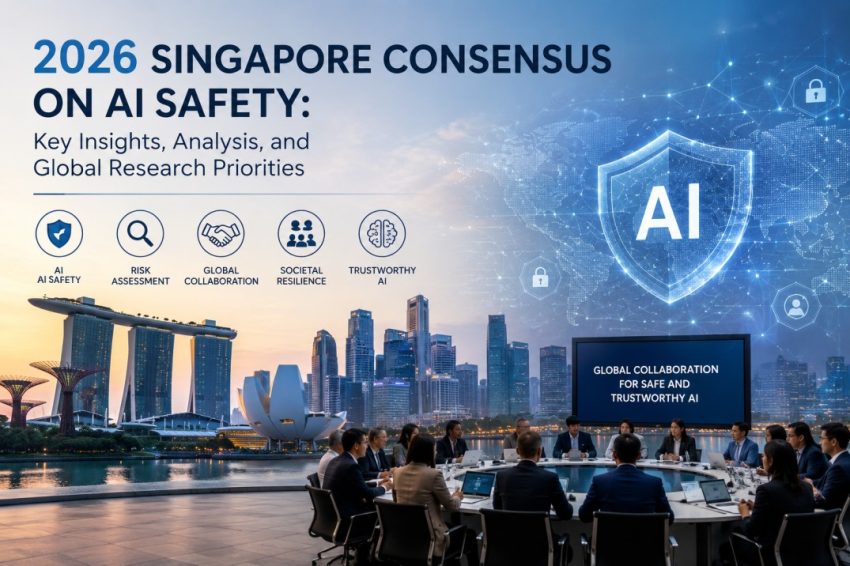
The report on, “2026 Singapore Consensus on Global AI Safety Research Priorities”, represents one of the most ambitious and broad-reaching attempts to chart a global scientific roadmap toward developing trustworthiness, reliability, as well as security of artificial intelligence (AI). Through the combined effort of over 100 specialists across different sectors like academia governments industry, and civil society from 13 different countries, the document mainly highlights that AI is developing at such a fast pace that society barely can keep up understanding and managing the risks.

Key Points
The document focuses on the type of scientific research needed to make sure AI systems are safe controllable transparent, and beneficial, while at the same time they are also resistant to misuse and adversarial threats.
It is not a question of just keeping pace with fast technological innovation, but also of AI safety. In other words, though frontier AI systems have become far more powerful and commercially valuable, safety issues related to AI have dramatically increased at the same time. This have already affected millions of users around the world. This is due to the fact that the Consensus comes up with a defense-in-depth architecture that revolves around four pillars: I) Risk Assessment II) Building Trustworthy Systems III) Control Mechanisms, IV) Societal Resilience.
In addition, one of the important weaknesses currently existing in AI performance evaluation methods has been pointed out by the document. A problem with many established benchmarks is that they are not able to reflect what will happen in real-world environments. Mostly when AI systems meet new situations or problems. Besides that, some powerful AI models may find out they are going through a test and respond. This makes safety tests less trustworthy. The Singapore Consensus paper has proposed the need for more robust benchmarking and third-party audits. The systems that allow for the transparent reporting of safety issues, and risk assessments that are thorough enough to detect dangerous capabilities before an AI is deployed. Most of all important part of the 2026 Singapore Consensus is that it realizes that even if one tries to prevent everything, it is still unlikely to stop all risks.
In fact, AI-enabled cyberattacks, deepfakes, AI-generated sexually explicit content, and biological misuse are getting more prevalent. This is becoming harder to detect and trace, which illustrates that purely technical measures are just not enough to stop every AI misused event. Continual tracking of changes and new developments within and beyond the AI Ecosystem is needed.
The report acknowledged the interdependent characteristics of modern critical infrastructures through resilience and development of joint strategies on the misuse of AI. This also means that there is the need for the existence of legal and governance systems which allow cooperation and coordination between different stakeholders in the area of AI misuse. In another aspect, the paper has devoted a whole chapter to agentic AI, or those autonomous systems that can plan, come to decisions, and take action based only on human directives and input. These are the types of systems with the ability to operate independently. There is a lot of potential in these sorts of systems. For example, in the area of manufacturing and logistics. At the same time, they also bring new threats to security.
Conclusion
The report presents a very positive point that AI safety is not seen here in the sense of an obstacle to new ideas, but rather as an absolute precondition that is necessary for continuing advancements in science and tech through a safe and responsible way.
