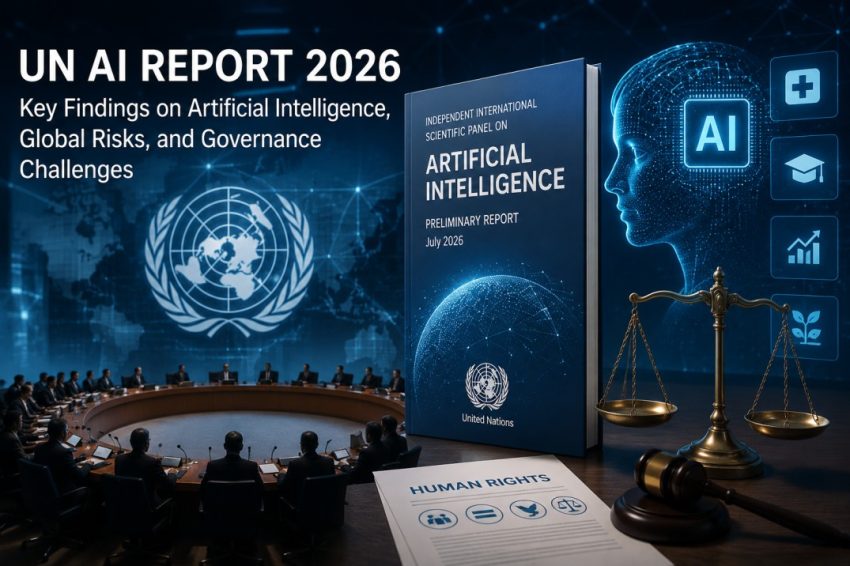
The United Nations’ Preliminary Report of the Independent International Scientific Panel on Artificial Intelligence (July 2026) offers a compelling, well-reasoned view of AI. This report shows how it can be a force for good or harm, the challenges to regulating it, and the role of governance in the future of AI. Instead of siding with the overly optimistic or the gloomy view of technology, the report recognizes that AI’s eventual impact will be a function of policy decisions, the readiness of institutions, and international cooperation.
Key Takeaway
AI capabilities have been outpacing governance mechanisms by a significant margin. Breakthroughs in logic, scientific discovery, software engineering, and autonomous decision-making have so far gone beyond the regulatory and oversight capacities of governments. Presently, AI safety checks are mostly self-regulatory by the tech developers. Because of this, it has created an information gap between tech firms and regulators. In this light, the report recommends getting third-party scientific reviews, developing unified assessment procedures, and empowering regulatory bodies to oversee the safe use of stronger and more complex AI systems.
Concentration of AI on the US & China
The report draws attention to the very limited number of countries and tech giants that control AI development. Actually, the U.S. and China have cornered the market when it comes to frontier AI research, computing infrastructure, semiconductor supply chains, as well as development of foundation models. Such a high concentration, on one hand, makes those two players very powerful globally and economically; Then again, countries that do not have AI capabilities will increasingly find themselves dependent on foreign technologies. This way, the report puts AI in the spotlight not only as a strategic economic resource but also as a geopolitical weapon.
Digital Divide
Building on this, the report introduces the idea of the “AI divide, ” which goes way beyond gaps in digital access. According to report, participating deeply in the AI economy takes a strong computing base, a pool of technically skilled people, high-quality datasets, a sound regulatory environment, and a supply of competent human resources. Unluckily, many developing countries are not even part of the AI governance process and so are at a disadvantage in setting international standards. To help with narrowing these inequities, the report recommends the building of sovereign AI infrastructure, raising AI literacy, skills development, and regional integration.
Transformative Potential of AI
Far from merely pointing out the negative side of AI, the report acknowledges the sheer transformative potential of AI. AI is actively enhancing health care via more accurate illness diagnosis, making scientific research speedier, boosting farmers’ productivity, opening more avenues to education, and providing greater accessibility for the less privileged. Though, these gains will only materialize if there are parallel investments in infrastructure institutions high-quality data, and AI interventions that are tailored to local contexts.
Agentic AI
Agentic AI is the next frontier of AI that the report sets forth as a huge governance problem. These AI agents operate independently without human intervention and are capable of formulating strategies, making decisions, carrying out tasks, as well as interacting with other AI systems. Even though such automation offers unprecedented productivity, it also brings about thorny challenges around accountability cybersecurity controllability, and human supervision for which current regulatory models are inadequate.
AI Risk
The report also stresses that with AI, risks to human rights and democratic governance keep going up. AI-enabled misinformation deepfakes algorithmic prejudice, mass surveillance, and AI systems with high persuasive power are risks to privacy equality faith in public institutions, and democracy. That’s why, the report sustains that AI governance should be based on human rights by way of making AI systems transparent, accountable and explainable, as well as via carrying out comprehensive human rights impact assessments from AI development to deployment.
Conclusion
Lastly, the report underlines that understanding AI and working together globally are key to properly governing AI. Governments must dedicate resources to educating people about AI, improving in-house skills, and becoming an active part of establishing worldwide rules. As AI creation is not limited to one country’s border, it is imperative to have global cooperative systems that set uniform standards, lessen disparities, and guarantee that AI is a tool for sustainable development while at the same time preventing major threats. In sum, the report sees the management of AI as a broadened issue that encompasses not only the technology itself but also economics. Geopolitics, human rights, and sustainable development. It is because of this, making global inclusive cooperation is the main determinant of AI’s future.
