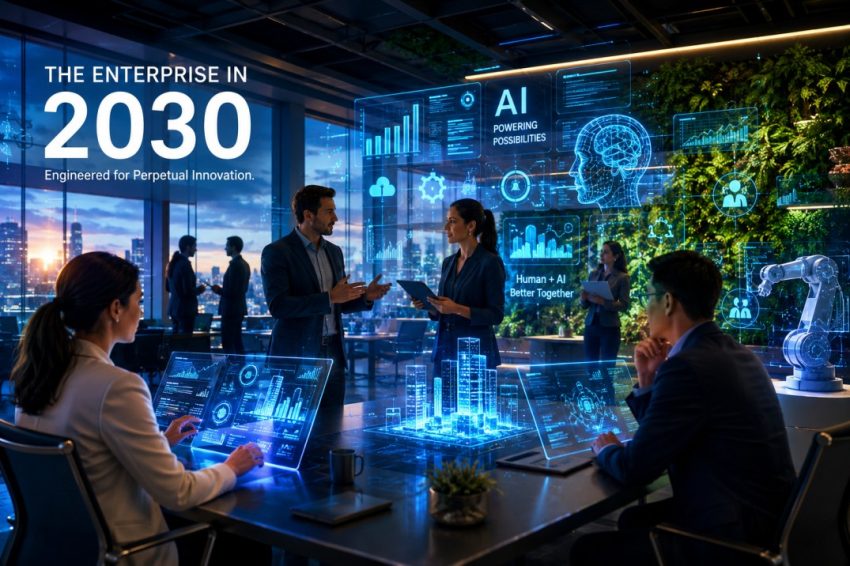
IBM claimed in its, “The Enterprise in 2030: Engineered for Perpetual Innovation” paper that future enterprises are going to be very different from organizations today. It will be a transition from being only AI-enabled to AI-first enterprises. They suggested that successful enterprises in 2030 will not be concerned just in automating their processes but even their whole operating model will be built around the concepts of artificial intelligence, continuous learning, and rapid adaptation. Companies will evolve into being more modular, dynamic, and making decisions in real-time rather than relying on the old-style planning cycles at intervals. One important discovery is that as much as 67% of executives think that AI will completely remove the current resource and skills constraints and 64% think that the main competitive advantage will come from innovation rather than resource optimization.
Key Points
The paper gives an overview of steps enterprises can take to ensure their survival. Firstly, the competition will be so tight that companies will have to put in a bigger effort and take more risks to get the results they want. This is because the speed of execution is everything whereas before it was decision-making precision. It is revealing that even though 79% of executives think that AI will be an important driver of revenue in 2030. In contrast, only 24% have a clear idea where their future revenues will come from, showing how uncertain and disruptive AI-driven markets going to be. Secondly, AI-generated productivity improvements will be the source of funding for transformations in the future.
Companies would manage to reach the level of up to 42% productivity enhancements while the leading firms will be the ones that channel the increased capacities of their employees to innovation, new products, acquisitions, and growth initiatives. Thirdly, largescale language models will not be the only ones where enterprises will rely on in the future, rather they will manufacture a customized combination of foundation models, small language models, proprietary data, as well as intelligent agents that perfectly match their specific business needs. Fourthly, organizations and the workforce will be subject to change due to the impact of AI. A lot of present jobs and skills will no longer be needed while there will be an introduction of new ones Mainly focusing on AI orchestration governance creativity, and strategic thinking. Also, value creation by humans will be more and more tied up with qualities such as judgment innovation critical thinking, and ethical oversight rather than mere routine knowledge work.
Conclusion
Last but not least, what is now anticipated as the next big technological revolution is the rise of quantum computing that will bring opportunities and competitive disruptions never seen before. The review, in general, asserts that with the enterprise of 2030 constantly driving innovation, always experimenting, embracing AI-human collaboration, and being able to react quickly to changing market conditions intelligence agility, and tailor-made AI capabilities will be the main determinants of success over time.
